Destination wedding guest management comes down to three deadlines. Set your RSVP date before the hotel’s room-block cutoff. Lock a rooming list with every guest’s passport name. And plan airport pickups from a live arrivals list, not a guess.
Get these right and your guests arrive, check in and reach the mehendi without a single frantic phone call.
For a Dubai wedding, there are extra steps. Most Indian guests need a UAE visa, every guest’s passport is checked at hotel check-in, and flights from India land at different terminals.
This guide shows you how to handle each one, step by step.
Why Guest Management Is Harder for a Destination Wedding
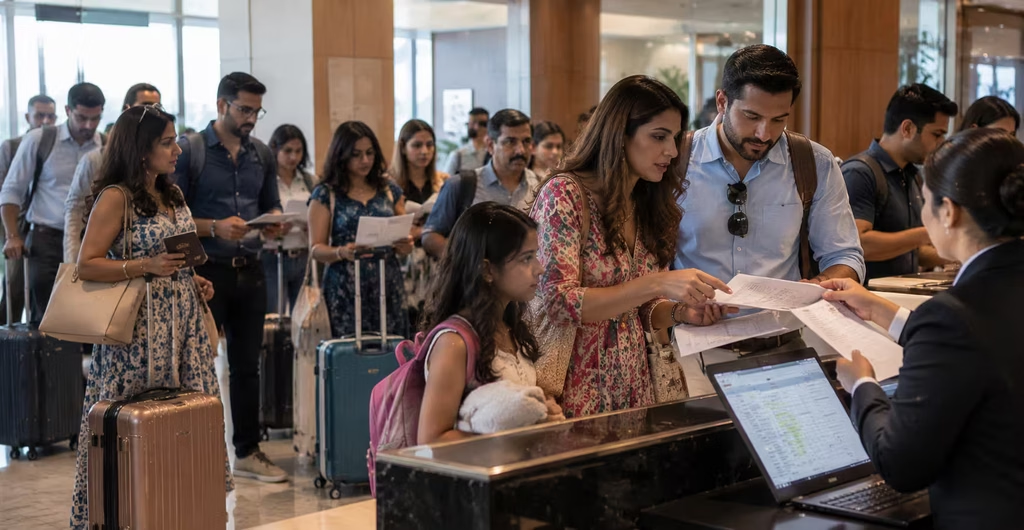
At a hometown wedding, a late RSVP means one extra plate. At a destination wedding, it can mean a missing hotel room, a visa that isn’t ready, or a guest stranded at the airport.
Indian weddings add even more moving parts:
- Large guest lists, often 200 to 500 people
- Multi-day functions across several venues
- Guests from many cities, arriving on different flights
- Elders, children and NRI relatives, each with different needs
The good news? Most problems come from the same few gaps, and each one has a simple fix.
The Guest Management Timeline for a Dubai Wedding
Work backwards from your wedding date. EasyWeddings recommends sending save-the-dates 6 to 12 months ahead for destination weddings, and formal invitations 10 to 12 weeks before.
| When | What to do |
| 9–12 months | Send save-the-dates; book the hotel room block |
| 4–6 months | Collect passport details for visas |
| 10–12 weeks | Send formal invitations |
| 6–8 weeks | RSVP deadline; start visa applications |
| 4–6 weeks | Hotel room-block cutoff; release unused rooms |
| 3–4 weeks | Finalise the rooming list |
| 2 weeks | Lock flight arrivals and the pickup plan |
| 1 week | Send guests their final travel pack |
Golden rule: your RSVP deadline must come before the hotel’s cutoff date. Most guest problems start when it doesn’t.
How to Handle Late RSVPs

Late RSVPs are the most common guest management problem. They’re also the easiest to prevent.
Why late RSVPs cost more at a destination wedding
Your hotel room block is a contract. Many contracts include an attrition clause, a minimum share of rooms you must fill.
According to Joy, most wedding hotel contracts set this minimum at 75 to 90% of the block, and 80% is the most common. If bookings fall short by the cutoff date, you may pay for the empty rooms.
So late RSVPs don’t just affect seating. They affect your budget.
Set an RSVP date that protects you
EasyWeddings advises setting your RSVP date at least a week before the venue’s final count deadline. For a destination wedding, set it before the hotel cutoff too.
For a Dubai wedding, aim for 6 to 8 weeks before the wedding. That leaves time for:
- releasing unused rooms
- processing UAE visas
- booking airport pickups
Make RSVPs easy to answer
Indian families rarely reply to formal cards on time. Make it effortless:
- Use WhatsApp. Send the RSVP link where families already chat.
- Ask one family head. One reply can cover the whole family unit.
- Use a short form. Name, functions attending, arrival date and passport status.
- Give a clear deadline. “Please reply by 15 November” works better than “kindly confirm soon”.
Follow a reminder plan
| Timing | Reminder |
| 2 weeks before the deadline | A friendly WhatsApp reminder |
| 1 week before | A personal message from the couple |
| 3 days before | A phone call from a family member |
| Deadline day | A final call to everyone still pending |
What to do with guests who still haven’t replied
Mark them “not attending” for room planning. Don’t hold rooms for them past the cutoff.
Keep a short waitlist. If they confirm late, book them at the hotel’s regular rate, or at a nearby partner hotel.
Be kind but clear. Tell them that rooms and visas after the deadline depend on availability.
Plan for the “maybe” guests
Every Indian wedding has relatives who say “we’ll try to come”. Track them separately as tentative. Don’t count them in your room block until they confirm with flights booked.
How to Manage Room Sharing and the Rooming List

A rooming list tells the hotel who sleeps in which room. It’s the backbone of guest management.
What your rooming list must include
For every room:
- each guest’s full name exactly as on their passport
- arrival and departure dates
- room type and bed type (king or twin)
- number of adults and children, with children’s ages
- special needs (accessible room, ground floor, adjoining rooms)
- the contact number of one guest per room
Passport names matter in Dubai
Hotels in Dubai check ID for every guest. Property Finder notes that all guests, including children, must show a valid passport or ID at check-in, and hotels copy passports and visas for official reporting.
What this means for you:
- Collect passport details early.
- Make sure every person sharing a room is listed, not just the person paying.
- A name mismatch can slow down check-in for a whole family.
How to pair guests in shared rooms
Group by family units first: Couples and parents with young children share naturally.
Pair singles carefully: Ask cousins and friends who they’d like to share with, and never assume.
Mind room occupancy limits: Standard rooms usually sleep two adults. Ask the hotel about extra beds, family rooms and child age limits.
Keep elders comfortable. Give them rooms close to lifts and function venues, and away from late-night parties.
Seat VIPs near the action. Place close family near the couple’s suite and the venue.
Is room sharing for unmarried couples allowed in Dubai?
Yes, in most hotels. Property Finder reports that unmarried cohabitation was decriminalised in the UAE after the 2020 legal reforms, and most hotels allow unmarried couples to share a room with valid ID. Some smaller hotels may have stricter internal policies, so check with your hotel.
Plan for the Tourism Dirham
Dubai hotels charge a Tourism Dirham fee per room, per night, shown as a separate line on the bill. The rate depends on the hotel’s category. Decide early whether you’ll cover it for guests or whether guests pay it at checkout, and tell them in advance.
How to Organise Airport Pickups in Dubai
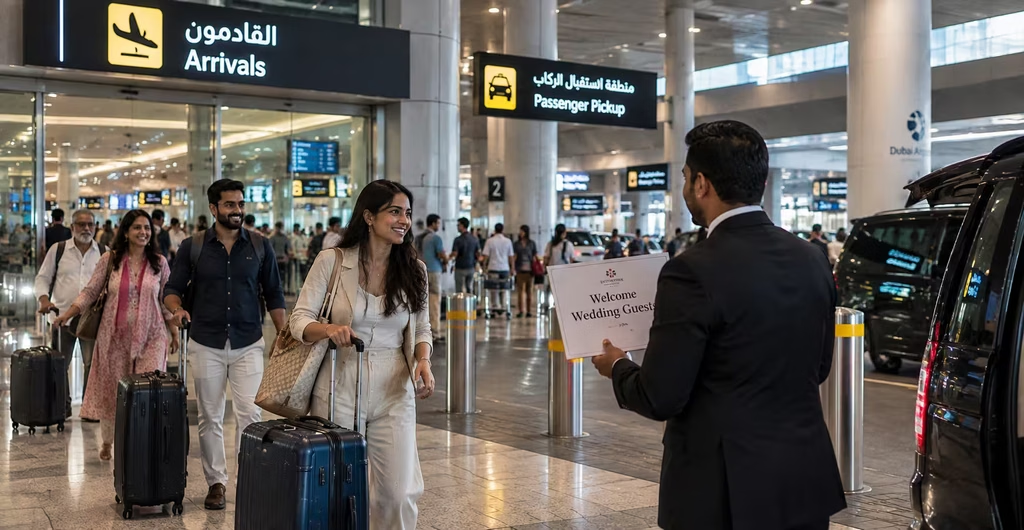
Airport pickups set the tone for your whole wedding. A smooth arrival makes guests feel welcomed. A missed pickup makes them feel forgotten.
Know which terminal guests will land at
Dubai International Airport (DXB) has three passenger terminals. Flights from India use different ones:
| Airline | DXB terminal |
| Air India, IndiGo, SpiceJet | Terminal 1 |
| Air India Express | Terminal 2 |
| Emirates | Terminal 3 |
| flydubai | Terminals 2 or 3 (check booking) |
Source: Zurich Kotak, using Dubai Airports data (August 2026). Terminals can change, so always check the boarding pass.
Tip: ask every guest to share their booking confirmation, not just their flight time. The terminal matters for where drivers wait.
Build a live arrivals list
Your arrivals list should show, for every guest:
- flight number and arrival time
- terminal
- number of passengers and bags
- hotel name
- the guest’s WhatsApp number
Update it as guests change flights. Changes are common.
Group arrivals into pickup windows
Don’t send a car for every flight. Group arrivals into time windows instead.
- Coaches or minibuses for large groups landing close together
- Private cars for elders, the couple’s parents and VIPs
- A dedicated luggage van for wedding outfits, jewellery cases and décor
Indian wedding guests travel with heavy luggage. Plan vehicle space for bags, not just seats.
Set up an airport welcome desk
For peak arrival days, place a coordinator at arrivals with:
- a printed and digital arrivals list
- clear signage with your wedding name or hashtag
- welcome water and snacks
- a direct line to every driver
Help elders and VIP guests
For elders or VIP guests, consider a meet-and-greet service. At Terminal 3, Emirates’ Marhaba service offers meet-and-greet with fast-track through immigration, and porters on some tiers.
Plan for late-night and early-morning arrivals
Many flights from India land late at night or early in the morning. Standard hotel check-in is usually in the afternoon.
Your options:
- book the night before for very early arrivals
- request early check-in in advance, though it’s not guaranteed
- arrange a hospitality lounge at the hotel where guests can rest and change
Plan transfer times realistically
Most wedding hotels are about 20 to 45 minutes from DXB, depending on the area and traffic. Allow extra time during peak hours. Never schedule a function to start right after a large group lands.
Compare locations in our guide to Dubai wedding destinations.
Don’t Forget UAE Visas
Visa delays are one of the biggest guest management risks for a Dubai wedding.
Most Indian passport holders need a UAE tourist visa before travel. Indians with a valid US visa or Green Card, or an EU visa or residence permit, can currently get a visa on arrival. The UAE has announced changes to these rules, so check before booking.
How to stay on top of it:
- Collect passport copies along with the RSVP.
- Check that each passport is valid for at least six months.
- Start visa applications as soon as RSVPs close.
- Track each guest’s visa status on your rooming list.
- Send approved visas to guests well before their flight.
See our Dubai wedding planning checklist for the full visa steps.
Send Every Guest a Travel Pack
One clear message prevents dozens of questions. A week before the wedding, send every guest a travel pack on WhatsApp or email.
Include:
- their hotel name, address and room-sharing details
- airport pickup details and the driver contact
- function schedule and dress codes
- what to carry at check-in (passport, visa)
- weather tips and what to pack
- an emergency contact number
Add ideas for free time from our guide to things to do in Dubai.
Should You Hire a Guest Management Team?
For weddings with more than about 100 guests, a dedicated guest management team usually saves the couple and their families a huge amount of stress.
A good team handles:
- RSVP tracking and reminders
- visa applications and status updates
- rooming lists and hotel coordination
- live flight tracking and airport pickups
- hotel welcome desks and guest support
At Dubai Weddings, guest management is part of every destination wedding in Dubai we plan. Browse our handpicked wedding venues in Dubai, or explore our Dubai wedding packages.
Still choosing a destination? Read our comparison of Dubai vs Goa vs Udaipur weddings.
Frequently Asked Questions
When should the RSVP deadline be for a destination wedding?
For a Dubai wedding, about 6 to 8 weeks before the wedding, and always before the hotel’s room-block cutoff date.
What happens if guests RSVP late to a destination wedding?
They may miss the room-block rate, and the couple may pay penalties for unfilled rooms. Book late guests at regular rates or a nearby hotel.
What is an attrition clause in a hotel room block?
A contract term that requires you to fill a minimum share of reserved rooms, often 75 to 90%, or pay for the shortfall.
What is a rooming list?
A list that tells the hotel which guests stay in each room, with passport names, dates, room types and special needs.
Do all guests need ID at Dubai hotel check-in?
Yes. Every guest, including children, must show a valid passport or ID at check-in.
Can unmarried couples share a hotel room in Dubai?
In most hotels, yes, with valid ID. Some smaller hotels may have stricter policies.
Which Dubai airport terminal do flights from India use?
Air India, IndiGo and SpiceJet use Terminal 1, Air India Express uses Terminal 2, and Emirates uses Terminal 3. Always check the boarding pass.
How do we plan airport pickups for a large wedding?
Use a live arrivals list, group guests into pickup windows, use coaches for groups and cars for elders, and place a coordinator at arrivals.
What if guests arrive before hotel check-in time?
Book the night before, request early check-in, or arrange a hospitality lounge at the hotel.
Do Indian wedding guests need a visa for Dubai?
Most do. Indians with a valid US visa or Green Card, or an EU visa or residence permit, can currently get a visa on arrival.