

Start 10 to 12 months out. Before you pay any deposit, settle three things: where you’ll be legally married, which guests need a visa, and whether your date clashes with Ramadan. Everything else can be fixed later. Those three can’t. Here’s the full Dubai wedding planning checklist, counting back from your wedding day.
Dubai wedding planning at a glance
| Decision | What to know |
| Start planning | 10–12 months before the wedding |
| Best months | November to March. November is the driest |
| Avoid outdoors | June to September |
| Ramadan 2027 | Expected to begin around 8 February. Eid Al Fitr expected 9 or 10 March |
| Legal marriage (non-residents) | Abu Dhabi Civil Family Court |
| Guest visas | Most Indian guests need a UAE tourist visa before travel |
| Questions for every venue | Minimum spend, outside vendors, ritual fire, music cut-off, taxes, cancellation terms, size of the covered backup |
Table of Contents
12 to 10 months before: the decisions that can’t wait
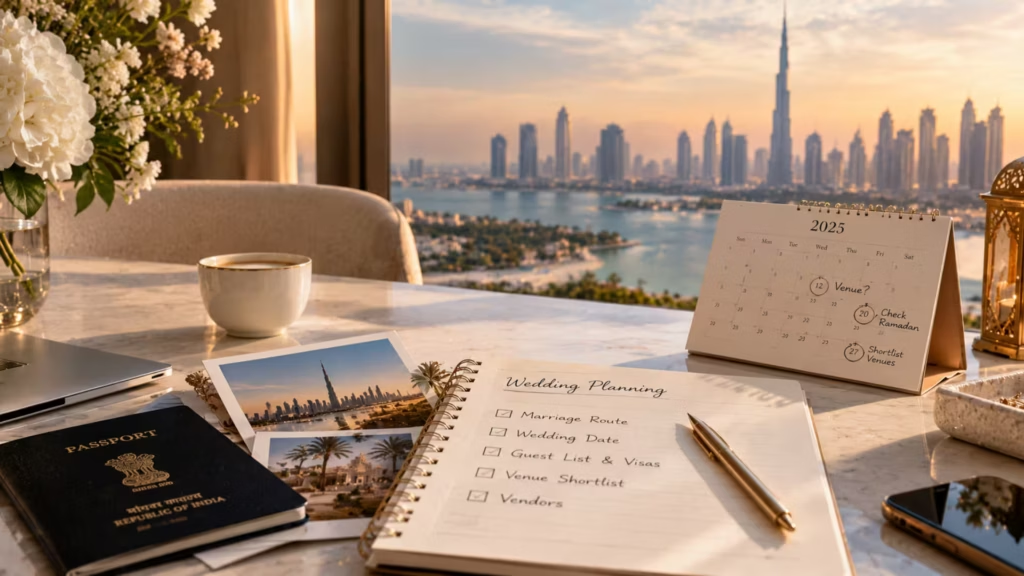
Goal: lock your marriage route, your date and your venue.
Your marriage route
- Decide which of the four routes you’re using. Not a UAE resident? The Abu Dhabi Civil Family Court is your route. Full detail is below.
- Confirm the requirements with that authority directly. Write the answer down before you look at venues.
Your date
- Shortlist two or three dates.
- Check each against Ramadan 2027, which is expected to begin around 8 February.
- Check against Eid Al Fitr, expected on 9 or 10 March. The best months and weather are below.
- Ask your pandit or imam for backup dates.
Your guests and events
- Count guests twice: those flying in, and those already in the UAE.
- Write your event list: haldi, mehendi, sangeet, pheras or nikah, reception.
- Decide who leads each ritual.
- Name one decision-maker per family.
Your venue
- Shortlist venues and ask all seven questions below. Compare options on our page of wedding venues in Dubai, or by area on our Dubai wedding destinations page.
- Get every answer in writing.
- Pay the deposit last, once your marriage route and guest visas are clear.
The seven questions to ask every venue
- What is the minimum spend?
- Are outside vendors allowed?
- Is ritual fire permitted, and where?
- What time must the music stop?
- What is the price with and without taxes and service charges?
- What are the payment and cancellation terms?
- Is the covered backup the same size as the outdoor space?
Move on when: you have a date shortlist, a venue and a confirmed marriage route.
9 to 7 months before: build your dream team

Goal: a visa plan in place and your team booked.
Visas
- Split your guest list into three groups: already in the UAE, qualifies for visa on arrival, and needs a visa. An Indian passport alone doesn’t qualify for visa on arrival. Who qualifies is explained below.
- Decide who applies: you, or each guest.
- Check eligibility on the ICP website, guest by guest.
- Send save-the-dates with a visa note.
Rooms
- Block hotel rooms, about one room per two guests.
- Ask what happens to unused rooms, and the release date.
Vendors
- Book décor, photographer, caterer and music.
- Book your pandit or imam.
- Confirm halal, vegetarian and Jain menus.
- Get every price and timing in writing.
Permits
- Ask the venue which permits apply for fire rituals, drones or live performers, and who files them.
- If you’re flying artists in from India, check which visa allows them to perform.
Move on when: vendors are booked, the visa plan is agreed and save-the-dates are out.
6 to 4 months before: invitations and paperwork

Goal: guests confirmed, paperwork started.
Guests
- Send invitations with a firm RSVP date.
- Collect each guest’s passport copy the day they say yes.
- Check that every passport is valid for at least six months.
- Remind guests to check UAE rules on any medication they carry.
Paperwork
- Start your marriage paperwork.
- Reconfirm every vendor and payment date.
Looks and food
- Book hair, make-up and mehendi artists.
- Fix trial dates.
- Order outfits and book fittings.
- Taste the menu.
Move on when: everyone has replied and you know who still needs a visa.
3 to 2 months before: lock the details

Goal: numbers locked, schedule written.
If you’re using the Indian Consulate route, publish your newspaper notice. It must appear 30 days before the wedding.
- Send final guest numbers to the venue and caterer.
- Confirm every permit is approved, and keep copies.
- Confirm your covered backup space.
- Finish the room list.
- Match every visa’s validity to the guest’s flight home.
- Plan airport pick-ups by flight.
- Plan transfers to each venue, including any desert or second-location event.
- Write a minute-by-minute schedule for each event.
- Name one person to run the day.
Move on when: the venue, caterer and vendors all hold the same numbers and timings.
The final month: almost there

Goal: hand it over and enjoy it.
- Rehearse entries and performances.
- Walk the ritual space with your pandit.
- Send guests the itinerary and dress codes.
- Give elders a one-page schedule in their language.
- Put contracts, permits and passport copies in one folder.
- Hand passports and rings to one trusted person.
- Pay final vendor balances.
- Eat breakfast on the wedding day.
After the wedding
- Married in the UAE? Get the certificate attested for use in India.
- Confirm when the photos and video will arrive.
Done when: everyone knows where to be, and one person owns the schedule.
Three decisions to confirm first
Everything above is the what and when. Here’s the detail behind the three decisions that shape the rest.
Where can you legally get married?
It depends on whether either of you holds a UAE residence visa.
| Your situation | Your route |
| Neither of you is a UAE resident | Abu Dhabi Civil Family Court |
| One of you has UAE residency | Dubai Civil Court |
| One of you is Indian with UAE residency | Indian Consulate, Dubai |
| You’d rather keep it simple | Register in India, celebrate in Dubai |
Abu Dhabi Civil Family Court :-is the only court in the UAE with no residency requirement. Tourists and visitors qualify on the same terms as residents, as long as both partners are physically in the UAE on the day. It runs under Abu Dhabi Law No. 14 of 2021, and applications go through the TAMM portal.
Dubai Civil Court:- requires at least one partner to hold a UAE residence visa. Without that, you’ll be directed to Abu Dhabi.
The Indian Consulate in Dubai:- solemnises and registers marriages under India’s Foreign Marriage Act, 1969. At least one partner must be an Indian citizen holding a UAE residence visa. You’ll need:
- a newspaper notice published 30 days before the wedding
- three witnesses with UAE residence visas
- a certificate of single status for each partner
This route isn’t available if either partner is Muslim.
The fourth option: register the marriage in India and celebrate in Dubai. Many families do exactly this.
This is general guidance, not legal advice. Confirm the current requirements with the relevant authority.
Which months work, and which to avoid
Ramadan and Eid 2027
Ramadan 2027 is expected to begin on Monday 8 February 2027. Eid Al Fitr is expected on 9 or 10 March, with a possible public holiday of several days around it. Both dates depend on the official moon sighting and can shift by a day. A wedding during Ramadan is possible, but venues set their own rules on music and dining hours. Get the policy in writing.
Best months
November to March, when evening temperatures are 14–20 °C and comfortable outdoors without heating or cooling.
| Month | Night temperature | Rain |
| November | 19.7 °C | 3 mm |
| December | 15.8 °C | 10 mm |
| January | 14.1 °C | 17 mm |
| February | 15.0 °C | 15 mm |
| March | 17.2 °C | 16 mm |
- November is the strongest month: comfortable nights and the driest of the five.
- January to March are the wettest months of the year. Rain is still unlikely on any given day, but keep a covered backup.
- October and April work for evening events only.
- June to September don’t work outdoors at all. Plan ballroom-only programmes.
Who needs a visa?
Most Indian guests do. An Indian passport alone doesn’t qualify for visa on arrival.
| Guest type | What they need |
| Already in the UAE | Nothing |
| Holds a qualifying visa | Passport plus that visa |
| Everyone else | Tourist visa before travel |
A qualifying visa means a valid visa, residence permit or Green Card from the USA, an EU member state, Australia, Canada, Japan, New Zealand, Singapore or South Korea. Those guests get 14 days on arrival. A UK visa or UK residence permit alone no longer qualifies, which changed in 2026.
Check each guest on the ICP website. Don’t assume, and don’t rely on what worked for someone last year.
Plan it with us
Bring three things to your first call: your date options, your guest split, and your event list.
We handle:
- venues and hotel rates
- décor
- vendors who know haldi and nikah alike
- pandits and imams
- Jain and vegetarian menus
- guest visas
- full execution on the day
We’ll also tell you which legal route fits your situation. See our Dubai wedding packages, or how we plan a complete destination wedding in Dubai.
Frequently Asked Questions
How far ahead should you start planning a Dubai wedding?
Ten to twelve months. Venues book quickly in the cooler months, guest visas need lead time, and the Indian Consulate route needs a newspaper notice published 30 days before the wedding.
Can Indian tourists legally get married in Dubai?
Not through Dubai’s civil court, which requires at least one partner to have a UAE residence visa. Couples where neither partner is a resident use the Abu Dhabi Civil Family Court, which has no residency requirement and accepts tourists, as long as both are in the UAE on the day.
Can you get married at the Indian Consulate in Dubai?
Yes, if at least one partner is an Indian citizen with a UAE residence visa. It follows India’s Foreign Marriage Act, 1969, and needs a newspaper notice 30 days in advance, three witnesses with UAE residence visas, and a certificate of single status for each partner. It isn’t available if either partner is Muslim.
When is Ramadan 2027?
It’s expected to begin around Monday 8 February 2027, with Eid Al Fitr expected on 9 or 10 March. Both depend on the moon sighting and can shift by a day.
Can you hold a wedding during Ramadan in Dubai?
Yes, but venues set their own rules on music and dining hours. Get the policy in writing before booking.
Do Indian guests need a visa for Dubai?
Most do. An Indian passport alone doesn’t qualify for visa on arrival. The 14-day visa on arrival applies only to Indians who also hold a valid visa, permit or Green Card from the USA, the EU, Australia, Canada, Japan, New Zealand, Singapore or South Korea. A UK visa alone stopped qualifying in 2026.
What is the best month for a Dubai wedding?
November. Night temperatures are around 19.7 °C and average rainfall is just 3 mm, the driest of the cool months.
Does it rain in Dubai during wedding season?
Rarely, but January to March are the wettest months, with January peaking at 17 mm. Keep a covered backup.
What should you ask a Dubai venue before booking?
Ask about the minimum spend, outside vendors, ritual fire, the music cut-off time, prices with and without taxes, cancellation terms, and whether the indoor backup matches your outdoor capacity.